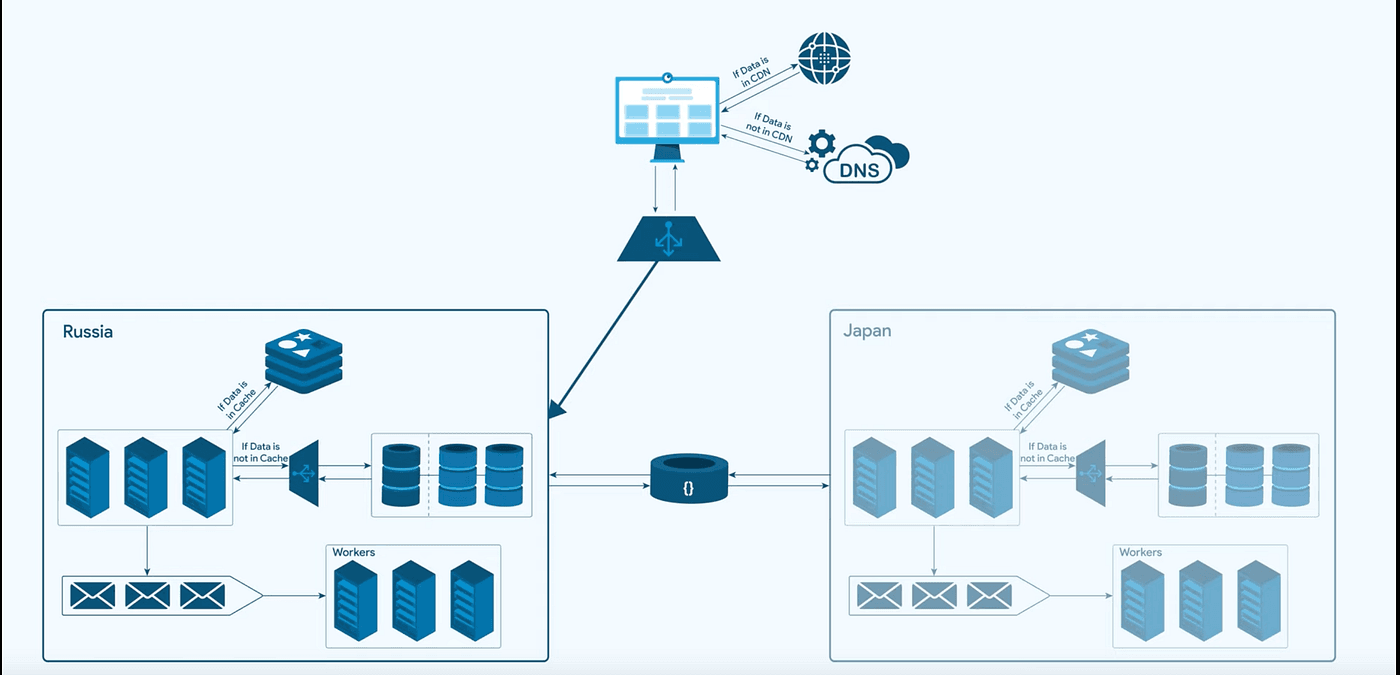

Software Architecture: Building a Scalable App to Serve Millions of Users

Software Architecture: Building a Scalable App to Serve Millions of Users
Building an application for a few hundred users is one thing.
Building one that can reliably serve millions is an entirely different challenge.
At small scale, many architectural decisions appear insignificant. A database query that takes 100 milliseconds may seem perfectly acceptable. A single server may handle the traffic comfortably. Storing everything in one place may feel convenient.
But as usage grows, those decisions begin to compound.
Millions of users introduce new demands around performance, reliability, security, data management, infrastructure, and cost.
The goal of scalable architecture is not simply to build a bigger application.
It is to build an application that can grow without becoming increasingly difficult or expensive to operate.
Start With the Requirements
Scalability begins before writing code.
Before choosing a database, cloud provider, framework, or architecture pattern, teams need to understand what the application actually needs to handle.
Important questions include:
A social platform, financial application, e-commerce platform, and internal business dashboard may all have millions of users but require very different architectures.
There is no universal architecture that automatically scales.
Start Simple, Then Design for Growth
Scalability does not mean starting with the most complicated architecture possible.
A common mistake is introducing microservices, event buses, multiple databases, containers, and complex infrastructure before the application has a genuine need for them.
Complexity has a cost.
A well-structured monolith can serve a significant number of users when it is properly designed and deployed.
The important thing is to establish clear boundaries within the application so that components can be separated later if necessary.
Build for today's requirements while keeping tomorrow's growth possible.
Horizontal Scaling
One of the fundamental principles of scalable architecture is horizontal scaling.
Instead of relying on a single powerful server, applications can run across multiple instances.
A load balancer distributes incoming requests between them.
If traffic increases, additional instances can be added.
This creates a system that can scale capacity as demand changes.
Horizontal scaling also improves resilience. If one instance fails, traffic can potentially be redirected to healthy instances.
Caching Reduces Pressure
Not every request needs to reach the database.
Caching allows frequently accessed information to be stored closer to where it is needed.
For example, an application might cache:
A cache can dramatically reduce repeated database work and improve response times.
However, caching introduces its own challenge:
stale data.
Teams need to decide what can be cached, for how long, and when cached information should be invalidated.
Databases Become a Critical Bottleneck
As applications grow, the database often becomes one of the first major scaling challenges.
Poorly optimized queries can become expensive when multiplied by millions of requests.
Scalable systems therefore pay close attention to:
The database architecture should reflect how the application actually accesses its data.
Adding more hardware cannot compensate indefinitely for inefficient queries.
Move Heavy Work Away From the Request
Users should not have to wait for every operation to finish before receiving a response.
Tasks such as sending emails, processing images, generating reports, importing large datasets, or running complex calculations can often be handled asynchronously.
A queue can receive the task while background workers process it separately.
This allows the application to respond quickly while heavier work happens in the background.
The result is a more responsive user experience and a system that can process workloads more efficiently.
Use Object Storage and a CDN for Large Assets
Applications serving millions of users can generate enormous amounts of traffic through images, videos, documents, and other media.
Keeping large assets directly on application servers is rarely the best approach.
Object storage can handle these files, while a Content Delivery Network (CDN) can distribute them from locations closer to users.
This reduces pressure on the application infrastructure and improves delivery speed across different regions.
For media-heavy applications, this distinction can make a major difference.
Reliability Is Part of Scalability
An application that can handle millions of requests but frequently goes offline is not truly scalable.
High-scale systems need to consider failure as normal.
Servers fail.
Networks fail.
Databases experience problems.
Third-party services go down.
Good architecture creates ways to absorb these failures.
This can include redundancy, health checks, automatic failover, backups, monitoring, rate limiting, and graceful degradation.
The objective is not to prevent every failure.
It is to prevent one failure from taking down the entire system.
Observability Matters
You cannot effectively scale what you cannot see.
Large applications need visibility into what is happening across the system.
Monitoring can track infrastructure health and resource usage.
Logging helps teams investigate errors.
Tracing can show how requests move across different services and identify performance bottlenecks.
Metrics provide data about latency, throughput, error rates, database performance, and other critical signals.
At scale, observability is not optional.
It is part of the architecture.
Security Must Scale Too
More users also mean a larger attack surface.
Authentication, authorization, encryption, rate limiting, input validation, secret management, and secure infrastructure all need to be considered from the beginning.
Security should not be something added after an application becomes successful.
Retrofitting security into a large system can be significantly more difficult than building secure foundations from the start.
Architecture Is a Series of Trade-Offs
There is no perfect architecture.
Every decision involves trade-offs between performance, cost, reliability, complexity, development speed, and maintainability.
A system designed for extreme traffic may be unnecessarily expensive for a small startup.
A simple architecture may eventually need to evolve as usage increases.
The skill lies in understanding when the trade-off is worth making.
Scalability is therefore less about following a checklist and more about making informed architectural decisions based on actual requirements.
Build Systems That Can Grow With the Business
Serving millions of users is not achieved through one technology or one architectural pattern.
It comes from many decisions working together:
Clear requirements.
Efficient application design.
Scalable infrastructure.
Well-designed databases.
Caching.
Asynchronous processing.
Reliable media delivery.
Observability.
Security.
Most importantly, it requires an architecture that can evolve.
The best scalable systems are not necessarily the most complicated ones.
They are the ones designed thoughtfully enough to handle today's needs while giving the business room to grow tomorrow.
Because ultimately, scalability is not about building for millions of users from day one.
It is about building a foundation that can keep working when millions eventually arrive.